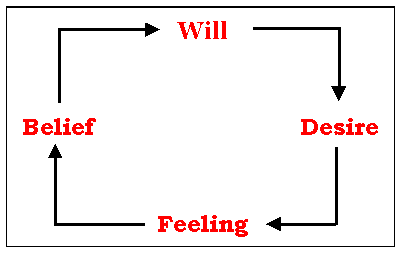
Primary Loop of Projection and Introjection
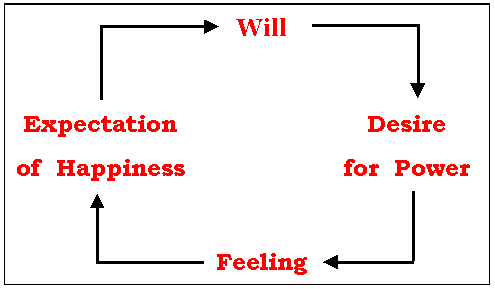
Secondary Loop of Projection and Introjection
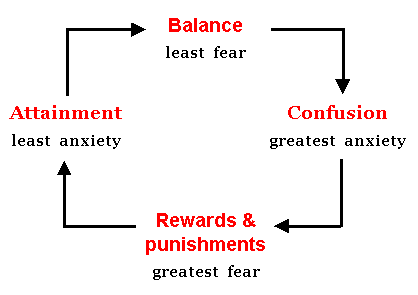
Loop of Becoming
| Home | Psychology
Section |
Introduction
|
The links in the table on the left take you to sub-headings on this page.
| Sub - Headings |
AbreactionThe term abreaction was first thought up by ancient Greek dramatists to describe the purging or cathartic effect that the release of emotion gives. Abreaction is actually a flow of different emotions, and it takes several forms. The overall effect is to release anxiety from the subconscious mind. What I have found is that some particular emotions are linked together to form four kinds of invariable sequence, which are ways in which the unconscious mind operates. These sequences link together positive emotions with negative ones, or happiness with unhappiness. |
| Changes of Terminology | |
| Definitions | |
| Diagrams | |
| Booklist |
I give the name abreaction to these sequences. The two main ones are the abreaction of guilt and the abreaction of pride. The first sequence links excitement to guilt and resentment, and the second one links sorrow and sadness to bitterness.
The
abreaction of guilt is the
sequence :
Narcissism leads to jealousy ; then jealousy leads to guilt ;
then guilt leads to resentment.
The
abreaction of pride is the
sequence :
Jealousy leads to narcissism ; then narcissism leads to pride ;
then pride leads to bitterness.
These
abreactions flow in a
dialectical way – thesis, antithesis, and then synthesis.
For example, in the abreaction of guilt :
Initially narcissism and jealousy produce excitement, and then we
end up with the guilt and resentment that oppose it. Finally we
have the steady state of detachment when the contents of the
excitement and the resentment phases no longer interest us.
Social Abreaction is just the extension of the sequences of abreaction to society as a whole, and they produce what I call laws of social change. The morality of an age determines what is good and evil, and these ideas form the content of social abreaction. The intensity of these abreactions depends on the rate of social change : the faster the change the greater are the effects of abreaction.
The first law of social change is the abreaction of guilt : it starts from a catharsis , which often contains left-wing or progressive views, but always ends in a right-wing backlash of resentment. Politically the resentment generates Conservative, even Fascist, attitudes.
The second law of social change is the abreaction of pride : it starts from sorrow and ends in bitterness. This abreaction usually ends in forms of Nazism, such as police death squads, the Stalinist political show-trials of the 1930s, and political or sectarian genocide. Bitterness is always worse than resentment. So Nazism is always worse than Fascism.
For an in-depth analysis, read the articles on Abreaction.
| Top of Page |
Antithetical thoughts are thoughts that are opposed to, or the antithesis of, other thoughts which the person prefers or which he /she intends to manifest in action.
If a person is contemplating the good things in life, then antithetical thoughts may arise and evoke ideas about the nastiness of life.
The physical body that is seen with the physical eye is only one part of human structure. The person capable of extra-sensory perception can see other ‘bodies’ that are associated with the physical one : these are the emotional body and the mental body. As a complex they are called the astral bodies of the person ; they are the vehicles for consciousness in higher planes of reality where there is no need to have a physical body
All matter exists in states of vibratory motion or energy. Each body has its own frequency of vibration. The matter of the physical body vibrates at the lowest rate, and the matter of the mental body at the highest rate. The vibrations from all the bodies fill the same space, like a radio spectrum.
Extra-sensory perception means nothing more than that the person has developed the ability to respond to these higher frequencies. Like any other ability, it is just a question of training.
The astral bodies of a person radiate energy which can be observed by extra-sensory perception. This energy field of a person can freely interact with the energy field of another person when they are close enough together, allowing the direct transmission of emotion from each to the other. The most important situation where this occurs, from the psychological perspective, is that between parent and infant – whilst being nursed the infant is constantly absorbing the parent’s emotions (both conscious and subconscious ones).
| Top of Page |
Energy centres in the astral/etheric body of a person. The kind of energy concerned is psychic energy, or energy that is utilised through will power or emotional moods. The chakras are associated with particular nerve plexuses in the physical body.
The psychological model that I use most of the time is a static one. This has three levels of activity: conscious, subconscious, and unconscious. However, when I need to describe agency I use a dynamic model.
Static model : consciousness is a state of being that has three modes, those of will, mind and feeling. Therefore, for me, consciousness is not the same as mind (and neither is mind identical to the brain). This model is for understanding how the various factors of consciousness relate together, in ways that are independent of agency.
Dynamic model : consciousness is a state of being that can act as a channel for agency. This model is for understanding the purpose of consciousness. Consciousness contains an agent, the ego, that can make choices.
Self-consciousness implies that agency is internal to the state of being, as in people and some of the higher animals. When consciousness has no aspect of self, as in insects and plants, then agency is external and utilises instinct (for example, such agency may be a group mind, and so consciousness would be a group consciousness).
Functional model : consciousness is a state of being that constructs a paradigm of reality from the results of awareness. This model describes what consciousness does. Awareness is that aspect of mind by which the agent develops consciousness.
The mechanism of this construction is thought. Thought is a sequence of awareness states, or thought is the activity of awareness. The content of thought can be images or words. Images are either images of something or an image of nothing (mental silence). Attention or concentration is the means of emphasising some states of awareness rather than other ones.
| Top of Page |
I use the term ‘dialectical ’ in the Hegelian sense. It represents a movement of thought through three stages. First there is the opening idea, the thesis ; then thought switches to the opposite conception, the antithesis. Finally both stages are blended together in the third stage, the synthesis. In moral ideas, if the thesis is a concept of goodness then the antithesis is a concept of badness. If the thesis represents some badness, the antithesis is that of some goodness. The synthesis is the resolution of the conflict.
Sooner or later a person reaches the point in his personal evolution when materialistic values and goals no longer completely satisfy him. He loses attachment to a materialist life when his level of sensitivity has reached the point that he can no longer find harmony in such a life. He can now become receptive to the influence of his higher self.
This influence can be labelled an "internal" drive, a drive that arises within his consciousness. This can be contrasted with "external" drives, when the person comes under the spell of external criteria, such as wealth, fame, etc, and becomes egotistically motivated to attain them.
When the person becomes receptive to his higher self, then he comes under the influence of one or more of four powerful internal drives: the desires for union, justice, freedom, and truth. His motivation becomes the way that he handles and directs these drives into suitable ideals. See also Motivation and Drives.
| Top of Page |
This is the personality ; it is the conscious aspect of the person, and excludes the subconscious and unconscious minds. It is agency, or the agent of consciousness. The ego has to make choices, and these produce effects. So the realm of the ego is the realm of cause and effect. See also Consciousness.
This is the ego with anxiety. More accurately, it is the ego in a mood of narcissism plus anxiety. So we witness an unpleasant ego. It is the anxiety which causes the unpleasantness.
A person can either act on his desires, using his will, or else follow his emotional responses. When he is focusing on his emotions, then his current state of consciousness has two main factors to it : a particular belief about some aspect of life, together with an emotional mood that is generated as the response to that belief. When the belief is not a conscious one, I call it an unconscious idea, whilst the mood is the activity of one or more particular emotions that maintain the physical symptoms. This activity I call the emotional dynamism, or the emotional dynamics, of the person's state of consciousness. The intensity of the state of consciousness depends upon the intensity of the mood.
I put this view another way. Any emotion is always a feeling (either positive or negative) that energises a mental concept associated with it. The mental concept is normally unconscious, so I call it an unconscious idea. Emotional dynamics are the principal unconscious ideas and their associated emotions that drive any particular state of consciousness.
When the mood is active, then the particular belief (whether conscious or unconscious) is active as well. When a different mood becomes active, so the belief changes to a different one, corresponding to the new mood. If the person no longer attaches any importance to a particular belief, then the corresponding emotional mood ceases to have any power over him. The mood loses its intensity.
Empiricism is the attempt to detect the basis of physical existence. In psychology it means the detection and identification of our states of mind, such as emotions, beliefs and desires. To identify our subconscious states of mind requires that we deepen our degree of self-awareness till we can first of all detect them, and then observe their effects on us. By cultivating an intuitive familiarity with them, we can deduce their characteristics and label them. A good way to begin psychological empiricism is to study and practice the Buddhist method of mindfulness. I describe my method of empiricism in the third article on Emotion, Identifying Emotions.
| Top of Page |
The process of making value judgements depends upon the psychological mechanisms of projection and introjection. Equanimity is the state of mind attained when the person ceases to make value judgements, and hence ceases to use projection and introjection. However, equanimity is extremely difficult to attain. The most effective way of stopping projection and introjection, at least temporarily, is to step outside of all value systems. The traditional Buddhist method of doing this is to practise mindfulness.
Existentialism takes the person as he is now, ignoring how he came to be. It is the way of exploring the meaning of relationships as the person experiences them now, without regard to past or future. What opportunities do they offer him? What kinds of freedom can he express within them? What forms of equality can be explored? The person explores relationships from a perspective centred on his own individuality. The states of mind that the person prefers to respond to are those of free will and choice.
Psychology takes the person as he has become, since it is his own history that is important for determining how he is now. The history of the person has helped to produce his present reality. And, in general, his relationships make up a large part of his history. Psychology is a way of exploring the value of relationships to the person. He explores relationships from a perspective centred on his social orientation. What needs do they satisfy? The states of mind that have the greatest effects on him are those of determinism and social conditioning.
An existential perspective means how relationships are understood now. A psychological perspective means why such relationships are as they are.
Another way of looking at these differences is to bring in the concept of two identities, by which I mean a person's focus on being either socially-orientated or orientated to being an individual :--
Psychological beliefs are concerned with values, the values that relationships have for the person. He explores what he gains and loses from his relationships. These beliefs provide a person with his sense of social identity.
Existential beliefs are concerned with meaning (and purpose), the meaning (and purpose) that relationships have for the person. He explores why he needs, or does not need, relationships. These beliefs provide a person with his sense of individual identity.
See Soul
| Top of Page |
This has two parts : rationality and intuition. Rationality is left-brain thinking, whilst intuition is right-brain thinking.
These two parts work together in conceptual analysis, that is, when we try to analyse something, when we think about concepts and their meanings. Conceptual analysis can be split into three modes:
Logical thinking – uses reason alone.
Dialectical thinking – uses both reason and intuition.
Relativistic thinking – uses both reason and intuition.
There are several forms of determinism : some are rigid (such as the social class that a person is born into), whilst others can be more variable (such as the effects of childhood conditioning). The Indian term ‘karma’ is ideal as a general-purpose term.
Overall, karma is the effects of a person's behaviours, actions, and thinking. The most important way to understand the concept of karma is that it is the effects of the fixed ideas, beliefs and attitudes that the person carries with him through life (and lifetimes!) : these aspects of character help to generate a person’s actions and behaviours.
Karma
has two forms, relative
and dialectical
.
One form relates to the person's behaviour and fixed beliefs (that
is, beliefs which have formed his character) ; whatever the
person does produces an effect. This form is a relative one, and
includes everything that is not caused by abreaction.
The other form relates to the mental processes, particularly to the subconscious mind ; when this is active, the person's mental states oscillate in a dialectical way. Abreaction is the source of this dialectical form of karma.
I use this term partly to denote intellect, and partly to denote the way that it helps to give rise to desires and emotions. It is not the same as consciousness.
This is a technique derived from Buddhist meditation that can be used to neutralise the power of desires and emotions. It is an essential component of the practice of self-awareness. It consists in watching states of mind instead of evaluating them or acting on them. Perception is switched into neutral mode, so that no values are projected or introjected. See equanimity. The cessation of judgement means that any state of mind, including madness, can be entered and experienced, without becoming engulfed by that state of mind.
The standard way of formulating mindfulness in a concise manner is :
in
the seeing,
only the seen,
in the hearing, only the heard,
in the touching, only the touch,
in the smelling, only the smell,
in the tasting, only the taste.
Hence no evaluation is made of sensory impressions.
| Top of Page |
A distinction needs to be made between moral rules that are adhered to because of the person’s social conditioning and moral rules that are accepted through free personal choice. I call ‘morality’ those rules that are a part of a person’s social conditioning ; these rules are subject to erosion from stress during periods of social change or in times of sorrow. ‘Ethics’ is the term that I use for the acceptance of rules through free choice and understanding. Another way to put this difference is:
Morality implies ideas of right and wrong based on social conditioning.
Ethics implies ideas of right and wrong based on critical reflection.
Motivation is the reason for following aims and desires. It is either the desire to experience something or the desire to achieve something, and takes the form of two drives (a drive is the energy component of motivation).
Primary motivation is egotistical and occurs through the desire to satisfy needs. This is the egotistical or ‘outer’ drive, since it relates to the influences on the ego of external factors ; these are usually materialism and social relationships that involve dependency, status or power.
Secondary motivation comes from the person’s ideals of ‘the good life’; this is an ‘inner’ (or hgher self ) drive since it focuses on spiritual influences that usually originate from the higher self. Although the higher self generates the inner drive, it is the ego that controls the expression of it. This control is exercised through the ego’s ideals. Only when the primary motivation is fulfilled will the higher self drive become pre-eminent. See also Drives.
There are three kinds of pain : physical, psychological or emotional, and psychic pain. To understand what psychic pain is, I briefly mention the process of bonding. Bonding has three factors, those of imprinting, identification, and transference. See note on Transference.
Psychic pain causes negative imprinting to occur. Ordinary imprinting occurs during childhood and causes a change in the structure of personal identity. However, psychic pain causes imprinting to occur at any age ; it also causes a change in the structure of personal identity. Because the change is negative, the person denies, is wary of, or rejects any kind of close relationship that may cause such pain.
| Top of Page |
Projection means that we imagine that our own virtues and vices and attitudes are embodied in other people. We see in other people what is in ourself. This psychological stratagem is particularly noticeable with regard to our vices. We try to escape from our faults by denying them ; we see them only as aspects of other people – it is always other people that are the source of conflict.
Introjection is the complementary process. We emulate the virtues (and vices) in the people that we admire. We incorporate into ourself the attitudes of people that are significant to us. Our own idealised image of ourself can also act as a source for introjection : we can use such an image as an object from which we can introject virtues that we need. It is through introjection that a child absorbs the values of the parents.
My use of ‘soul ’ is equivalent to the term ‘higher self ’. Soul is the source of spiritual idealisms, and it is ‘the silent watcher ’. Another common name is ‘the witness’. The soul is a ‘higher self ’ to the ego (this should not be confused with the creation by an ego of an idealised ‘self ’). The soul acts as a guide to the ego, trying to steer it through the confusion of a human life. The ego reincarnates (though in a complicated manner), but the soul does not.
In the model of consciousness that I have adopted, I separate the non-conscious regions of the mind into two parts, because it is evident to me that some aspects of non-consciousness are personal to the individual whilst other aspects are common to everyone. I decided to call the personal aspects the subconscious mind. My usage of the terms subconscious and unconscious are as follows.
I
use the term subconscious
mind
for what is personal to
the individual,
and the term unconscious
mind for what is
general to
humanity.
I also call the unconscious mind the collective mind. My desires and ambitions have roots in the subconscious mind, whereas emotions are common to everyone and so come from the unconscious mind. Also, in history we sometimes see the production of mass movements and social revolutions of various kinds – political movements, cultural movements, sexual movements, etc – and these originate in unconscious influences and so represent the collective mind.
For me, spirituality does not necessarily equate to religiosity. A religious person can also be spiritual, but a spiritual person does not have to be religious. A religious perspective is a self-sufficient belief system containing only acceptable values and meanings within it. It is a belief system that has boundaries around it, since the world of the subconscious mind is excluded from it. A spiritual perspective can be more open and flexible. I view spirituality as the attempt to live in harmony with life. This view entails the necessity to aim for harmony in all of one’s personal relationships and situations.
Emotions are partly derived from ideas or mental concepts that influence us below the level of normal consciousness. The mental concept that is associated with an emotion actually creates the boundaries of that emotion. If the mental concept changes, the emotion does not change ; instead, it fades away and a different emotion arises, one that fits the current mental concept. To work out the underlying concept, the overall theme or motif of the emotion needs to be considered, that is, what the emotion is trying to express.
Emotions are not unique to any particular individual, so the ideas or concepts that underlie them come from the unconscious mind. Since the concepts are unconscious they are extremely difficult to identify. The concept is normally unconscious, so I call it an unconscious concept or an unconscious idea. The first article on Emotion contains a list of some important unconscious ideas and their associated emotions.
| Top of Page |
| Changes of Terminology |
Up till now the terms ‘catharsis’ and ‘abreaction’ have been more or less synonymous. Since I need a new word to label some invariable emotional sequences, I have separated these two terms.
I name the invariable sequences ‘abreaction’ , and restrict the term ‘catharsis’ to the stage of excitement that begins just one particular sequence. Catharsis is now simply the first stage in the abreaction of guilt.
I need to make a distinction in the origin of character traits since they have two different roots. Some traits of responsible behaviour are social ones, and others are purely aspects of individuality. In order to label these roots I use the terms ‘morality’ and ‘virtue’. Traditionally these two terms have been treated as being more or less identical, but now I separate them.
Where
the social traits are
produced by
social
learning I call them aspects of morality.
Where the individual traits arise as a reaction to social
conditioning I call them virtues.
When some deliberate choice is involved in determining one's standards then I use an opposition of ‘ethics’ against both morality and virtue. Conditioning and learning just affect behaviour. Deliberation brings in motives.
I consider ethics to be the critical and clear-minded analysis of the problems of right and wrong, good and evil.
I define virtues. Virtues
are noble attitudes that
spring from the heart.
It is not easy to explain what
virtues are. In effect, they are based on feelings and so are
non-linguistic.
The person may ‘explain’ his approach to life by
saying
that he prefers to follow the dictates of his heart.
I define morality. Morality
is a linguistic product
made into a social practice.
A morality in any age is the sum of
socially-accepted desires and values in that age. These values
are a part of language ; they can be articulated and so can be
made the object of rational analysis.
The reason for the difference is that morality centres on language, virtue on consciousness.
When intellectual and critical thought (within the framework of psychological awareness) is applied to morality and virtue, so that they can be analysed and self-deception removed, then morality transforms into a social ethics and virtue becomes an ethics of individuality.
| Top of Page |
| Definitions
etc |
The parts of the mind that are hidden from normal consciousness consist of the subconscious mind and the unconscious mind.
I
use the term ‘subconscious
mind
’ for what is personal
to
the individual,
and the term ‘unconscious
mind ’ for what is
general to humanity.
Desire
is the activity of will
directed into a mental concept.
Emotion
is the activity of
feeling directed into a mental concept.
An emotion is an unconscious idea powered by either a pleasant or an unpleasant feeling.
Some emotions have an additional complexity : they are compound and consist of two simpler emotions. The factors do not exert their influence simultaneously ; only one is dominant at any particular time. I use the term mode to indicate which factor is being dominant at that time, that is, to indicate the manner in which the compound emotion is being experienced. A summary of the factors of some important emotions is :
Guilt
= self-pity + self-hate.
Pride = vanity + hatred of other people.
Narcissism = love + vanity.
Jealousy = love + self-pity.
Anxiety
= fear + vanity.
Paranoia = fear + pride (mode of vanity).
Resentment = guilt + idealism.
Bitterness = pride + idealism
Repentance
= regret +
guilt (mode
of self-pity).
Sadness = regret
+
jealousy (mode
of self-pity).
G.E. Moore summarised a certain perspective in philosophy derived from Immanuel Kant
... just as, by reflection on our perceptual and sensory experience, we become aware of the distinction between truth and falsehood,
so it is by reflection on our experience of feeling and willing that we become aware of ethical distinctions.
| Top of Page |
A psycho-analysis is the method of intentionally removing anxiety from the subconscious mind.
The
meaning of anxiety is that
it eliminates complacency.
The purpose of anxiety is that it facilitates change.
For the sake of brevity I write of the abreaction of guilt, pride, etc, whereas in fact it is the anxiety attached to these emotions that is abreacted.
The three parts of bonding, of the ‘transference’ situation, are imprinting, true transference, and identification. The emotion is always jealousy.
Imprinting centres primarily on the patterns of femininity in the mother and masculinity in the father.
Transference reveals aspects of character (‘ what I am ’ ).
Identification reveals aspects of identity (‘ who I am ’ ).
Transference itself can be split up into two broad factors, one focusing on sexuality and the other focusing on authority. Each parent is a source of both factors.
Sexual transference is the pattern of the parent’s sexual attitudes that is admired in other people.
Authority transference is the admiration of the pattern of authority and morality that is exerted by the parent.
| Top of Page |
Projection and introjection are the means of handling values.
Projection
and
introjection
are
form.
Transference and egoism are content.
When two or more people are close enough together so that their auras touch and blend (a distance of about five to six feet or less), emotions can freely pass from one person to the other (this phenomenon in the therapy situation is called the ‘counter-transference’ ).
Equanimity means the cessation of making value judgements, and hence the cessation of the mechanisms of projection and introjection.
Anxiety
is the ground of the social use of
projection and introjection.
However, for the individual centred within their egoism, the
ground of projection and introjection is vanity alone.
There
are two factors
that need
to be separated :
that which concerns
the
control of the will, and that which concerns how the will is used.
The loop of projection and introjection has two parts : the use of the will and the control of the will. The first part leads to the desire to control one's environment and relationships, and the second part to self-control.
Desire for power = jealousy (in self-pity mode) + pride (in vanity mode).
Will to power = envy + narcissism (in mode of vanity).
| Top of Page |
Anxiety is the sense of uneasiness that is experienced in the individual's social and political relationships with other people, or in the relationship with one's own soul.
When a new process, a new practice, a new quest is instituted in society or in the individual, it is begun at the level of feeling and emotion. It reaches its culmination, perhaps even its perfection, when it achieves the level of insight and intellectual understanding.
I split sexuality into two
factors, calling
them sexual
desire
and sexual
attraction.
Sexual attraction arises when the person is sexually stimulated
through the vanity mode of narcissism.
Sexual desire arises when the person is sexually stimulated
through the self-pity mode of jealousy.
| Diagrams |
Primary Loop of Projection and Introjection
Secondary Loop of Projection and Introjection
Loop of Becoming
| Top of Page |
Direction of Love Flow between Two Partners
For an harmonious
partnership
the man sees in the woman what is repressed in him, and the woman
sees in the man what is repressed in her.
or
An harmonious relationship means that the woman’s femininity
reflects the man’s own femininity, and the man’s
masculinity reflects the woman’s own
masculinity.
The four ways in which love is flowing harmoniously between them is indicated below:
a).
When a man satisfies the woman's need for validation, the masculine in
him is dominating the feminine in a
woman.
The flow of love is from man
to
woman.
Man:
jealousy (love mode)  woman: jealousy (self-pity mode).
b).
When a man is experiencing
narcissistic love the feminine in him is responding to the
feminine in a woman.
The flow of love is from man to
woman.
Man:
Narcissism (love mode)
woman: narcissism (vanity mode).
c).
With a woman of strong will
the masculine in the man responds to the masculine in the woman.
The flow of love is from woman
to man.
Man:
narcissism (vanity mode)  woman: narcissism (love mode).
d).
When a woman satisfies the man's
need for validation, the masculine in the man is dominated by the
feminine in the woman.
The flow of love is from woman to man.
Man:
jealousy (self-pity
mode)
woman:
jealousy (love mode).
When the relationship is not harmonious, then love does not flow in these ways.
| Top of Page |
| Booklist |
Blackham, H.
Six
Existential Thinkers.
Routledge, 1952 and 1986.
Brentano, Franz.
Psychology
From an Empirical
Standpoint. 1874.
Translation:
Routledge Kegan Paul, 1973.
Brunton, Paul.
--- The
Hidden Teaching Beyond Yoga.
Rider 1941.
On philosophical
idealism, and the differences between philosophical thought and
religious/mystical thought.
--- The
Wisdom of the Overself.
Rider 1943, 1972
--- The
Notebooks of Paul Brunton.
Larson Publications, USA.
A series of books.
Freud, S.
Introductory
Lectures on
Psychoanalysis.
Pelican
Gross, Richard.
Psychology.
3rd edition.
Hodder & Stoughton
1996.
Hesse, Hermann.
Autobiographical
Writings.
Triad
Panther, 1985.
Hollingdale, R.J.
Nietzsche.
Routledge
&
Kegan Paul, 1973.
Laing, R.D.
--- The
Divided Self.
Penguin, 1987.
--- The
Politics of Experience.
Penguin,
1990.
--- Self
and Others.
Penguin,
1988.
Mann, Thomas.
Tonio
Kroger. This is a
short
story contained in:
Death
in Venice and Other Short
Stories.
Heinemann, Secker
& Warburg, 1983.
Moore, G.E.
Principia
Ethica.
Cambridge,
1903. (sections 78-79).
Nietzsche, Friedrich.
--- Beyond
Good and Evil.
Translated
by W. Kaufmann. USA,
Vintage, 1966.
--- On
the Genealogy of Morals/
Ecce Homo.
Translated by W.
Kaufmann. USA, Vintage, 1969.
--- Thus
Spoke Zarathustra.
Translated
by R.J. Hollingdale.
Penguin, 1988.
Nyanaponika, Thera.
The
Heart of Buddhist Meditation.
Rider,
1983.
A standard exposition of mindfulness.
Paterson, R.W.K.
The
Nihilistic Egoist: Max Stirner.
Oxford
University Press,
1971.
Rousseau, Jean-Jacques.
--- Confessions.
Penguin, 1970.
--- Reveries
of the Solitary Walker.
Penguin,
1979.
Rogers, Carl.
Client
Centered Therapy.
Constable,
1984.
Stirner, Max.
The
Ego and His Own.
Translated
by Steven Byington. London,
1907. Also, The Modern Library, USA.
| Top of Page |
Copyright
© 2026
Ian Heath
All Rights Reserved
The
copyright is
mine, and
the articles
are free to use. They can be reproduced
anywhere, so long as
the source is acknowledged.
Ian Heath
London, UK
If you want to contact me, use the address at the bottom of the Home page.
Also, since there are numerous articles on this site, please include the title of the article if you want me to clarify or discuss particular issues.
It may be a few days before I can respond to correspondence.