| Home | Binary Consciousness. Chapter 3: Nature of Language | Table of Contents | Introduction | Glossary |
| < previous | next > |
The links in the table on the left take you to sub-headings on this page.
| . |
Two Ways of ThinkingMy mode of thinking is to use language. So I think verbally. However, it is not the only way to think. Many people who are proficient in visualisation and meditation may think visually. How does the way we think affect the way that language evolved? I contrast two topics. a).
A comparison
between visual thinking and verbal thinking. These are two separate topics. My answers are mainly derived from analysing my states of mind, which are almost purely verbal. I do not visualise, at least not distinctly. When I try to remember a person, a scene or anything else that is visual, only very vague and indistinct shapes come to mind – it would be a mockery to call them images. ( This is a reflection of how I see the world: my viewing is impressionistic. I do not pay close attention to detail. I prefer to pay attention to my thoughts instead). |
| Sub - Headings | |
| The Issue of Emotion | |
| Public Language | |
| The Psychological Loop | |
| The Language Loop | |
| I
give some Examples of the Language Loop |
|
| Community
Conflict |
|
| References |
However, a different process occurred when I used to meditate. As I attempted to clear my mind of thoughts, to the extent that I was successful at that task I would be defeated by the unwanted generation of visual images. These images would be much clearer than the indistinct shapes that I can call up from memory.
I interpret these results to mean that verbal thoughts have visual images “underneath” them. In the generation of thought, visual images seem to be basic, but are hidden by a superimposed layer of verbal activity.
Many scientists and intellectuals have poor ability in imagery. Perhaps most of the lay public can produce good imagery. I assume that the development of the intellect often has the effect of repressing the thinker’s power of imagery.
In conscious visual imagery, signs and concepts are represented differently from corresponding linguistic ones. A visual image – a tree, a geometric design, abstract art – does not neatly divide into subject and object in the way that a proposition does. A visual sign is “holistic”, whereas a linguistic sign can be analysed into components (a signifier and a signified). All in all, a visual sign is different from a linguistic sign in important ways.
| Top of Page |
I consider the how and the why of language, or how and why did language originate in times of long ago?
The primary, basic method of thinking is non-linguistic (as in animals and the Early cavemen and aboriginal hunter-gatherers of long ago). This method uses a flow of conscious visual impressions. From this flow the person creates signs and concepts, which are his relationships to external reality. This is a private language, based on signs and semantic meaning. This is rather like the way a baby creates its private language (its own words for the teddy bear, the rattle, the face of the mother, etc).
The limitation of a private language is that it cannot be communicated to other people. To establish a way of communicating, the private language has to give way to a social, public language. Now grammatical language is invented, as a secondary method of thinking. This is the reason why language originated, as a means for public communication. The conscious flow of visual imagery now tends to be relegated to the subconscious as verbal activity comes to dominate the mind.
The origin of language can be considered to be a dialogue between emotion and desire (or emotion and will power). Language is a filter mechanism; by centring himself on it, the person can learn to disregard much of the sensory input that his nervous system receives from internal and external sources. Consider hallucinatory agents, such as LSD. When we take LSD we become responsive to a much greater range of sensations than we normally do; some of these sensations have an external source, but there is also an emotional or mood response, with little will power in evidence. In fact, the stronger that our will power is, the higher the dosage of LSD that is required in order to start the hallucinations. The LSD experience is primarily an experience of altered perceptions, perceptions that normally we have taught ourself to repress and filter out.
I discovered the effect of will power on drug experiences during my middle 20s. My flatmate at that time was raised in an orphanage and so was emotionally labile. When we took the same dosage of LSD, he would hallucinate quite easily, whilst usually I would be merely stoned. My will power often prevented any loss of sensory control.
| Top of Page |
Consider Early man in the time of long ago. There is little public language and a great range of sensory input, some of it of a psychic nature (as is evidenced in genuine shamans, medicine men, witch doctors, etc). So I presume that early man was highly emotional, with an undeveloped will.
As language ability grows, so concepts of public activity grow too. The concepts channel sensation into “approved” patterns, and help stabilise emotional swings. Whence will power grows in tandem with the concepts and the activity. Man’s susceptibility to domination by emotion decreases with time. This process is ongoing, and leads eventually to the practice of self-control. As man’s conceptual ability increases, his developing will power enables him to begin the process of acquiring self-mastery (by learning to control his emotional moods).
There is a problem here. To control emotional susceptibility only through the use of will power is unskilful, and leads to the psychological problems of repression. Repression works effectively only in low-stress societies. A major reason for the development of language is to enable the mind to formulate methods that can harmoniously direct the will in the control of emotion. An example of harmonious method is the Buddhist technique of mindfulness. The development of language is the necessary condition for the eventual development of reasoning ability. Without language, man oscillates perpetually between emotion and desire. Rationality is needed primarily for its stabilising effect on both mood and desire.
The world of abundant emotion, or more particularly, the world of LSD, has a great appeal to many people. The world of LSD, which I found a fascinating one during my 20s and which I believe should be available, legally, to anyone who wants to experience it, is the world of Early man. It is a dream world, interspersed with occasional psychic phenomena. It was the starting position of human development – it is not the goal. I see the LSD experience as reminder of where we came from.
In the 1960s, Timothy Leary saw the same experience as an indicator of where we are going. Leary came from a background of behaviourist psychology. So he probably desired, subconsciously, to be more emotionally free. My background is one of emotional turmoil, and so I desire the control of emotion by the intellect (or by high ideals).
| Top of Page |
Public language produces grammar, together with the restrictions that grammar places on the “match” between linguistic signs and visual signs. Because of the differences between language and vision, a grammatical language of the Western type is never a true copy of external reality. In Western languages, the person has been “inserted” into the grammars of the languages (producing the subject-predicate division). Western languages insert the person “into” the external reality that he is perceiving. This makes Western languages self-referential: such languages orientate around the observer, not around external reality.
In languages such as Hopi, which do not place any importance on a subject-predicate division, language may be more “visual” and less self-referential. I explore this idea further in the article on Benjamin Lee Whorf.
Creative thinking is not
dependent on language; creative thinking occurs outside the boundary of
the person’s current linguistic range and associations of
ideas. Non-creative thinking depends on language, since it stays within
the boundaries of the person’s existing beliefs. The
challenge for the creative thinker is to develop language in order to
be able to communicate his original ideas.
I summarise the steps to the creation of public language.
c).
Private language arises first, by the separation of the flow of visual
imagery into signs and concepts that carry meaning. The limitation is
that of semantic determinism: semantics controls what can be thought.
d).
Public language is created in order to communicate ideas and other
thoughts. Rules of analysis are invented and produce the limitation of
grammatical determinism: grammar controls what
can be thought.
These steps can be denoted by popular views on child development, assuming that the child “replays” all the stages of human evolution. The stage of private language and self-discovery is the Piaget stage. Then grammatical language develops independently of cognitive needs and thinking – this is the Vygotsky stage. Eventually linguistic “relativity” is created and we have the Bernstein stage (using “relativity” in the traditional sense).
Piaget originated the idea of learning by stages; individualism was primary. Vygotsky thought that social learning was primary. Bernstein looked at the relative differences in vocabulary and language use between working-class and middle-class children.
| Top of Page |
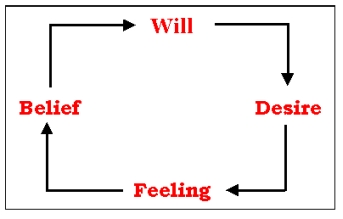
The primary basis of social interaction is psychological and centres on the unconscious mechanisms of projection and introjection, which form a closed loop of desire and feeling/emotion. This loop is the way of handling long-term desires.
Language is modelled on the psychological loop of projection and introjection: the more complex that the latter are, the more sophisticated the language becomes. Since projection and introjection form a closed loop, so thereby the use of language also forms a closed loop.
For the simplest form of the psychological loop I use two definitions from my psychology studies. First, feeling combines with mind to form emotion. There are just three feelings: the neutral, positive, and negative ones. Though there are a host of emotions. Secondly, will (or will power) combines with mind to form belief. [¹]
I use these two definitions to create diagram 1: Primary Loop of Projection and Introjection. Here, will links to feeling via the mind by using desire: desire is the way of using the will. And feeling links to will via the mind in its aspect of belief: belief is the way of controlling the will.
Diagram
1
Primary
Loop of Projection and
Introjection
Beliefs can focus on subjectivity or objectivity. Subjectivity contains meanings, whilst objectivity (which is needed for the language loop) contains values. The subjective individual creates meanings, and if they are useful to society then they are taken up as objective social values.
Subjective beliefs carry meaning: for example, “I need to maintain my integrity”. Meaning has no necessary specific content. Objective beliefs carry value: for example, “it is wrong to be violent”. Values have specific (that is, linguistic) content.
I illustrate the difference between meaning and value. The meaning of eating an apple is that it removes stomach agitation or that it produces pleasant sensations of taste. The value of eating an apple is that it is good for health.
| Top of Page |
I bring together some isolated issues in 20th-century Anglo-American moral philosophy in order to form the language loop. My ideas, when applied to language theory, can integrate some issues in ethics. In my study of twentieth-century ethics I found ideas on commands, emotivism, and intentions, but no ability to put them together harmoniously. To put them together I bring in my ideas on the use of language. This use can be modelled on the psychological loop, so that we get the language loop. This is given in diagram 2: The Loop of Language.
Diagram
2
The
Loop of Language.
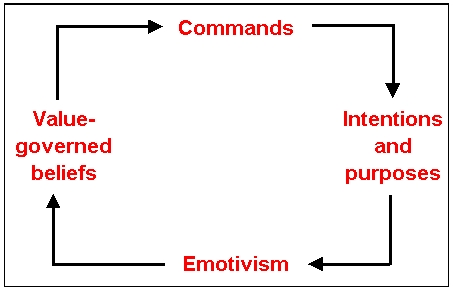
In this loop, commands direct intentions and purposes. The latter generate suitable emotions, which then help us sustain our important beliefs. These beliefs give forcefulness to the commands.
In the psychological loop, will can be considered to be a command to participate in non-linguistic activity. Will by itself has no specific content. Examples: “eat!” ; “travel!” ; “seek power!” ; “be creative!” (creativity depends on intuition and so is non-linguistic).
Like will, commands have no specific content. Self-commands are usually subconscious: for example, “be friendly to people!” ; “think of tomorrow!” ; “think about problem Z!” ; “be curious!”. Social commands are conscious: for example, “do what you are told!”. We need to be aware that some expressions are more complicated than they seem at first. For example, an expression such as “sit up straight!” is actually a compound of “obey me!” (the command) and “sit up straight” (the content or intention).
When it is necessary to formulate intentions and specific goals or to understand states of mind then the person has to gravitate from the psychological loop to the language loop. The psychological loop may be biased towards non-linguistic activity and vague preferences, whilst the loop of language enables the person to be explicit and decisive in what he wants. Inability to switch easily between the two loops is the major difficulty encountered in the early stages of a psycho-analysis.
Intentions and purposes are the content to which the command is the form. Emotivism means that intentions and purpose arouse feelings and emotions in the person. These emotions generate favourable or unfavourable beliefs and attitudes. Language is value-orientated, so the beliefs are governed by values rather than by meanings. These beliefs, in turn, help give power to commands. Emotivism and value-governed beliefs provide the dynamics of the loop: emotivism is usually short-term and the belief is long-term. Putting these components all together, we can see that: -
Language is made up of form, content and dynamism.
| Top of Page |
e). I might have an ideal or intention to pursue a sexually-restrained way of life. I then generate negative feelings about sexuality. These feelings then sustain beliefs such as "sexual preoccupations slow down my own evolution". These beliefs can empower commands such as “eliminate weakness from my character!”. The power in the command reinforces my ideals.
f ).
Science is the methodical pursuit of curiosity about the material
world. The command centres on curiosity (“be
curious!”) and not on truth, since the scientist is just as
prone to bigotry and narrow-mindedness towards his work as a
non-scientist is towards his. Scientific observation comes under the
heading of belief: it is assumed that there is some value to that which
is being observed. The emotivism may be the love of truth or the love
of beauty. In mathematics there is the aesthetic satisfaction in
deriving formulae which are concise and neat.
g).
In ethics, ethical commands have no specific content and represent
Kant’s categorical imperative. The emotional use of language
is observed in moralistic speech. When moral discourse is emotional it
aims at influencing, changing or controlling the values and
value-governed beliefs of other people.
h).
Emotionally-laden advertising and propaganda take a different approach
from ethics. They usually avoid a head-on challenge to values. They are
more effective when they try to influence meanings through the use of
symbolism and stereotype. The acquisition of a stereotyped or symbolic
better image of oneself is usually the intention. Since meaning is
often non-linguistic the effect of advertising can be hard to resist
– the person cannot put into words how his meanings have been
attacked and so finds it hard to refute the attack.
The language loop indicates that the use of language does not relate to
reality but only to concerns about its own values. I put this view
another way. We do not see the world as it really is. We see the world
only from the perspective of our values. It is our values that create
objectivity, not the world. Objects have no self-values. Objects cannot
create objectivity. It is only consciousness that can do that.
| Top of Page |
Language structures the world. Disputes occur between countries or communities because they structure the world differently. Disputes occur because the languages are different. Language is the primary source of division in the world.
This fact has an interesting consequence: when the language is the same between disputing parties, then the focus of the disputes has to take a secondary source of conflict. Language contains values. When the language is the same for the disputing parties then the primary stock of values is also the same. Conflict has then to centre on secondary values. In other words, in any language community, sources of conflict are always of a secondary nature and are never primary. Therefore in such cases the social rifts can be healed eventually. But when language itself is the source of division then social rifts may, perhaps, never be mended.
I give some examples, with the last two being current at the time of writing, in 1998:
i).
Latin was the common language of medieval Europe. This meant that when
social divisions occurred in the sixteenth century they had to focus on
secondary values. The Reformation centred on religion, and so different
religious beliefs were taken as the means of creating separate regional
identities. Religion is always a secondary source of value. If
vernacular languages had been common then the Reformation would have
taken these languages as the means to create separate regional
identities and religious disputes would have been of secondary
importance.
j).
In Northern Ireland the community division is over religion. This
occurs only because Irish is English: the two languages are
approximately the same,
so they cannot be taken as a source of different values.
k). The contemporary situation in Quebec, where the French-speaking part of the population wants to separate from “English” Canada, is an illustration of the primacy of language.
When language is the same in any community then a favourite way of expressing division is to focus it on religious values and doctrines. Conversely, to create a stable religious ecumenism requires the necessary condition that several different languages be involved and no attempt is made to establish any particular language as the language of discourse. Once different languages are accepted as the framework of discourse then disputes can be understood to derive from the different ways that the participants structure the world. The world is always structured linguistically before it is structured in any religious manner. When the differences are allocated to language and its embedded values then the path to religious harmony is open.
A
religious Eden
can never have a universal language!
or
The
condition for Eden to be a universal paradise
is that it contains more
than one language.
| References |
[¹]. The two definitions, and the differences between emotion and feeling, are taken from the article Emotion 1 on the Home page. [1]
| Home | Glossary | Top of Page |
Copyright
© 2026
Ian Heath
All Rights Reserved
The
copyright is
mine, and
the articles
are free to use. They can be reproduced
anywhere, so long
as the source is acknowledged.
Ian Heath
London, UK
If you want to contact me, use the address at the bottom of the Home page.
Also, since there are numerous articles on this site, please include the title of the article if you want me to clarify or discuss particular issues.
It may be a few days before I can respond to correspondence.