| Home | Binary Consciousness. Chapter 3: Nature of Language | Table of Contents | Introduction | Glossary |
| < previous | next > |
The links in the table on the left take you to sub-headings on this page.
| . |
Effect of Change on SocietyLanguage incorporates social values. What is of value to society is incorporated into language to produce standards, ideals and goals. Society changes when that which is of value to society changes. Then the social changes, in turn, produce changes in language. Social changes affect values in ways that have not been accurately understood before. Normally social values are the same as linguistic values when the society is a stable and unchanging one. However, once society starts changing, then language change produces special effects. The primary basis of social interaction is psychological and centres on the loop of projection and introjection, which forms a closed loop of desire and emotion.[¹]. This loop is the way of handling long-term desires. The use of language forms a closed loop too, since it is modelled on this loop of projection and introjection. The difference between the two loops is simply that the psychological one is based on individual meanings and the linguistic one on social values. |
| Sub - Headings | |
| Process | |
| Diagram 3. Sequence of Social Change | |
| Language and Morality | |
| Language and Ideology | |
| Two Language Phenomena | |
| References |
This link between language and social values is one of identity, but only as long as society is static or is evolving slowly. In a static society, the language is the society. Society is its language. The two are one.
Now there are two sign systems, those of language and of consciousness.[²]. In the two sign systems, consciousness is fundamental and language is only derivative. Consciousness is dynamic and so it can change fairly easily, whilst language is fairly static.
In times of stability the
dynamic structure of consciousness is put on hold, so linguistic values
and social values are one. Tradition rules: the values of society do
not vary. However, as society changes so the dynamic structure of
consciousness gradually comes into the foreground. Perhaps it is more
accurate to put this effect the other way around: as the dynamic
structure of consciousness becomes accentuated,
so society begins to change.
As
society changes, social values and
linguistic values begin to
diverge.
Language contains traditional values – this is what is implied in the ideas of social conditioning and social learning. In a static society, traditional values are unquestioned. Hence social learning takes the form of social conditioning. Social conditioning is the unquestioned or confused adherence to social norms, and occurs when society is taken to be self-referential.[³]. A static society sees itself as the judge of its own needs.
The only circumstance that normally breaks social conditioning in some degree is change. Therefore in a period of fast social change, chaos occurs as social norms are questioned, altered and perhaps even rejected. New norms are slowly generated. This chaos ensures that society can no longer be regarded as being self-referential.
In this situation of chaos, language is grasped as being self-referential. Then language is no longer necessarily tied to social reality. In such times, values change as the values within language change and we may witness radical innovation in artistic genres.
For example, the nineteenth century saw the focus on art for art’s sake, along with science for science’s sake (neither art nor science were to be dependent on values external to themselves, such as social usefulness). Then the problem of grappling with the new possibilities of language produced the dense symbolism of the French poet Mallarmé. In twentieth-century literary theory the text has become autonomous and self-contained, and/or the reader has acquired total freedom in his interpretation of the text.
| Top of Page |
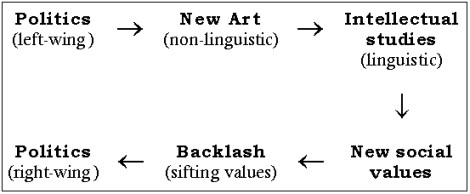
To explain how this process happens I bring in politics. Consider a static, unchanging society. This has conservative, even right-wing, social values and a rigid hierarchy of authority or power. Society and politics have coalesced into a uniform model of conformity.
Initially this model suited contemporary needs. But as evolution progresses and new needs appear, which cannot be met under this model, so the existing social norms become a handicap to progress. This restrictiveness on human development eventually becomes challenged. Activists and non-conformists begin to initiate social change by confronting the system of authority. Thinkers give direction to new ideas on freedom and justice. Left-wing politics are born.
Social change intensifies emotional responses. These new emotional intensities bring forth creative abilities in art. Change is always handled intuitively before it can be expressed in intellectual ideas. Art is the herald of linguistic change. New directions in art are usually born in the catharsis stage of social abreaction.[4]
Once new genres of art have become established, the intellectual attempts to verbalise their meanings and the reasons for their birth start to separate language values from social values. The clarification of such intellectual ideas is a slow process. Language is no longer necessarily tied to social reality: language becomes self-referential.
As social change moves into the stage of abreactional backlash the new linguistic values are sifted and assessed, and only those needed to solve current problems are retained. Society again becomes centred on right-wing politics; such politics attempt to return society back into a stable, static state. If this attempt is successful, then the new model of stability is more in tune with contemporary needs than the previous model was. This stability occurs when social values have “caught up” with the new linguistic values. Then once again society and language become one.
The overall sequence is given in Diagram 3: Sequence of Social Change. The arrows can be read as “leads to”. So left-wing politics leads to new art, which in turn leads to intellectual studies, etc.
| Top of Page |
Diagram 3: Sequence of Social Change
Note
The French
Revolution misled nineteenth-century political theorists. Due to
unusual circumstances, the peasantry became left-wing in their
politics. This led some theorists to
presume that being left-wing is the normal state of the bottom levels
of society. Whereas, in my view, the normal state for all levels of
society is to be right-wing, since the majority of people dislike
social change and prefer traditional values rather than experimenting
with new ones.
Different genres of art may move through this sequence at different speeds and at different times from each other. So there may be mini-sequences of social change overlapping each other.
The sequence of social change that I have outlined shows that any society is really a language community. The individual transforms his subjective meanings into objective social values via language. Values have to become incorporated into language before they can become incorporated into the stock of social values. Language brings forth the social reality.
Language creates society.
This relation is not apparent in static societies; it is easy to assume that society antedates language. Even “primitive” societies are no exception. A “primitive” society is one where language use is primitive, and indicates hunter-gatherer tribes; yet a tribe cannot be established until the necessary linguistic signs for authority are created.
Society cannot be created until a group of people have some values in common. And values require a language to embed them and articulate them. It is language that brings people together and keeps them together. Language always precedes society. Even in small groups this relation holds: for example, in a political discussion group the people come together because they already have, or want to learn, a common political language.
| Top of Page |
The examination of language will, sooner or later, bring with it the need to examine morality as well. Language and morality intertwine with one another. I use the term morality to indicate the norms and values that are produced by social conditioning. Where norms and values are the result of personal choice, then I use the term ethics instead.
For an idealist, morality is more often a hindrance than a help. The reality of childhood means that the child is unable to assess current social values and norms, so he has to absorb them without any prior critical reflection. He absorbs them by his relationships to his parents and other significant adults. So moral codes are just the rationalised presentation of social conditioning.
When an idealist attempts to put his ideals into practice he can sometimes face a mountain of difficulties. One of the main problems he faces is that of the social control of his thinking. The traditional means for controlling thinking is that of moral codes. The issue that morality presents to the free thinker is that moral values can quickly become out-of-date in a fast-changing society. If a thinker is more evolved than the society he lives in, then social values can easily become a barrier to the creation of the new ideas that society will eventually need. Then the task for the free thinker is to revalue existing values, as the German philosopher Friedrich Nietzsche foresaw.[5].
Morality is a social construct and is centred on values. Language is the repository of values. And some of these values are moral ones. So morality comes within the sign of language. This relationship can be defined as follows.
Morality is a linguistic product made into a social practice.
Nothing can be made into a social practice until it can be communicated, until it can be expressed directly in language. For comparison, the subjective individual uses his virtues of character to control his thinking. Virtues of individuality are natural and flourish outside of morality, outside of language. Such virtues centre on the sign of consciousness.
When value is postulated to reside in language, its terminus is morality. When meaning is postulated to lie outside of language, based on natural feelings (and not conditioned ones), its terminus is individual virtue.
| Top of Page |
When Saussure explored semiology, he failed to take into account the nature of ideology.[6]. An ideology is a self-contained system of ideas and values that ignores or rejects everything that is outside the boundaries of those ideas and values. Capitalism is the present form of materialism. As a projection of an ideology of arbitrary values onto nature, materialism (and hence Capitalism) approximates to an Idealist framework.[7]. In so far as language supports this framework then language is an ideology too, and so this sign finds its use within the capitalist mentality.
Consciousness can be analysed as a sign system. However, the sign of consciousness is non-linguistic (it arises prior to language), so when it is explored it takes the individual out of ideology and out of dependence on capitalism as a system of values. The person prefers to be guided by his subjective convictions. As an example, the French thinker Jean-Jacques Rousseau preferred to follow the tender sensibilities of his heart instead of the dictates of society!
In general, ideology, as a self-sufficient system of values, is created when the sign of language is projected onto reality, that is, when reality is constrained to fit within an arbitrary valuation. Ideology thus becomes a social form of philosophical Idealism – the world is seen as we are socially conditioned to want it to be.
Projection and introjection are functions of consciousness. Hence they also apply to its derivative, the linguistic sign. Projection, as an outward-looking mechanism, centres on values. Introjection, being inward-looking, centres on meanings. In language it is the signifier that is structured, and so contains value.[8]. I bring in ideology as a form of social persuasion. I split up the sign of language into its two components.
In
the sign of
language:
a).
Projection of the signifier produces value based on
ideological domination: the person has his values determined for him.
b).
Introjection of the signified produces ideological
meaning:
the person
subjects himself to social control.
Compare
the
sign of
consciousness:
c).
Value is
projected in the form of phantasy or
imagination: this gives rise
to
creativity.
d).
Meaning is introjected
by reality testing (or
empiricism): reality is used for originating new concepts, new patterns
of thought.
| Top of Page |
I end this article with two examples of my ideas.
e).
Ethnic Destruction
Language is modelled on the loop of projection and introjection. This
makes possible a destructive cultural phenomenon. When a foreign
language is imposed on a group (or ethnic minority) that group is
eventually destroyed. When a person changes his primary language, or
even his culture, he automatically changes his pattern of projection
and introjection. The moral codes embedded in his ethnic language
largely disappear and he absorbs a new morality from the new language
that he has embraced. Hence his needs change. His old way of life will
gradually disappear.
There are two qualifications to this view. The rate of change depends on how related the languages are: the more related they are, the more gradual is the change. Secondly, immigrants may only speak their adopted language in their social roles in the adopted society; they many retain their ethnic language in their family settings. This retention of the ethnic language slows down the cultural destruction of the group.
Abandoning native languages leads to a melting pot pattern of immigrant assimilation. This pattern cannot work in the long-term, since the immigrants’ old sense of identity is destroyed and a new one has not yet been built. A new sense of identity cannot be created without community support, and this is often lacking for the immigrant.
A cosmopolitan culture is much better than a melting pot culture, and is better suited to the widening possibilities in the choice of values that is opening to the modern world. Therefore, in today’s age of cosmopolitanism, it is bad politics and bad psychology to try to persuade immigrants to abandon their native language. The task for the immigrant is to keep his language and learn the new language of the host society; this way he can then create a new identity that sits between his old identity and the cultural "norm" of the host society.
f
). The Pursuit of Truth
Times of change produce a
special phenomenon: the pursuit of truth. In times of change, social
values (representing tradition) and language values begin gradually to
diverge because they begin to reflect different needs, those of
tradition and those of modernity. Within this “gap”
arises the possibility of pursuing the search for truth. This gap
allows the observer to view both social values and language as
separate realities that are running on parallel courses. Truth is
always the result of comparing the old with the new.
In a static society, social values and language are one; there are no means of attempting a re-valuation of existing values. Tradition is the only mode of knowledge. It is always major change that produces the possibilities of new truths.
In a static society, the pursuit of truth can never arise.
| References |
[¹]. For more information on projection and introjection, see Glossary. [1]
[²]. The two sign systems, those of language and consciousness, are explained in earlier articles in chapter 3.[2]
[³]. The self-reference of society, and of language, is described in the article Problems of Language. [3]
[4]. Catharsis and abreaction are explained in the articles on Abreaction on the Home page.[4]
[5]. Nietzsche examined moral codes and morality in two books, Beyond Good and Evil, and On the Genealogy of Morals. [5]
[6]. See book by Culler, Jonathan. Saussure. Fontana Modern Masters, 1976. [6]
[7]. By an Idealist framework, I mean a framework of mentalism, the view that something is purely a formation of the Mind. This is also called Philosophical Idealism. [7]
[8]. For understanding synchronic and diachronic, see the article Structuralism. [8]
| Home | Glossary | Top of Page |
Copyright
© 2026
Ian Heath
All Rights Reserved
The
copyright is
mine, and
the articles
are free to use. They can be reproduced
anywhere, so long
as the source is acknowledged.
Ian Heath
London, UK
If you want to contact me, use the address at the bottom of the Home page.
Also, since there are numerous articles on this site, please include the title of the article if you want me to clarify or discuss particular issues.
It may be a few days before I can respond to correspondence.