| Home |
Landmarks
of Spirituality
|
Section 3 : Stages
|
| < previous | next > |
The links in the table on the left take you to sub-headings on this page.
| . |
Forms of EthicsIn the previous article on Conflict within Idealism, I mentioned the conflicts over views of ethics. I give a short precis of the three forms that ethics can take. Ethical ideas can focus on objectivity, or on subjectivity, or on relativity. Each focus has its place in the gradual evolution of the person, that is, the person will adhere to the particular form of ethical theory that best suits his current degree of evolution. In order to understand the process of personal evolution, I use a conceptual scheme having three levels, since I believe that there are three general levels of spiritual attainment. These levels are denoted by the focus on faith, love, and equanimity. [¹] |
| Sub - Headings | |
| Three Ideals | |
| Progression | |
| An Idealistic view | |
| Diagram 1 - Loop of Becoming |
|
| End note | |
| References |
Varieties of objective ethics focus on rules for governing what is considered to be morally right, wrong, or obligatory. Rules allow for identical responses to repeated occurrences of any particular situation. The person’s subjective evaluation of the situation is of no real importance.
Rules
are common to a
group
or a society, and are of two main kinds
: they take the form either of:
‘We
ought
always to
keep our promises
’. [objective form
of ethics of duty],
or of
‘Our
practice
of always keeping
promises is for
the greatest general good ’.
[objective form of
utilitarian ethics].
Here the concept of duty is switched to oneself. A subjective ethics is only the duty to oneself: the duty to focus on the development of self- consciousness.
Varieties of subjective ethics focus on principles (instead of rules) for governing what is considered to be morally right, wrong, or obligatory. What the person feels is the most important current consideration determines what his response will be. Hence when exposed to repeated occurrences of any particular situation, his responses are likely to differ since he may use different principles. His subjective evaluation of the situation is of primary importance, and so he prefers to use intuition rather than pre-set rules as the basis of judgement.
Judgements
are individual,
and are of two main kinds : they take the form either
of:
‘In
this
situation I
should tell the
truth ’.
[subjective form of ethics of duty],
or of
‘In
this
situation my
telling the
truth is for the greatest general good ’.
[subjective
form of utilitarian ethics].
| Top of Page |
The concept of relativity is mis-understood in thinkers and scientists. For example, in continental cultural theory, the linguistic sign is taken to be arbitrary (from the work of Ferdinand de Saussure). However, the linguistic sign is not arbitrary, it is relative (in the sense that I use it). Whence much of continental cultural theory is of poor philosophical quality. If something is relative, it is neither arbitrary nor purely subjective. [²]
I
give a general
definition of
relativity :
Relativity
is a relationship between
something that
is objective and something that is subjective.
or,
A
relative relationship contains both
objective and subjective factors.
The kind of ethics suitable for a relative spirituality is that called ‘Virtue ethics’. This has a long history, being discussed by Plato and Aristotle in their analyses of desirable character traits that the philosopher ought to have. In fact, though, virtue ethics can be practised even when the person is focused on either objective or subjective ethics. In relative ethics, character traits and virtues are developed subjectively in order to handle objective situations.
I highlight the differences between the three forms of ethics
Objective ethics : the external situation (or objective situation) is focused on, and subjectivity is minimised.
Subjective ethics : subjectivity is focused on, and objectivity is minimised (since at different times the ‘same’ situation can evoke different subjective responses).
Virtue ethics : both subjectivity and objectivity are equally important.
| Top of Page |
I return to the idea of the three levels of spirituality: faith, love, and equanimity. I look at these levels again in order to tie them to my view of consciousness. Consciousness has three components, those of will/desire, mind, and feeling/emotion. [³]. Each component takes turn to be emphasised on the ladder of personal evolution. A person makes sense of each level by focusing his /her efforts on a particular ideal. In describing these levels I use the ideals that have motivated me.
Level
1. This
orientates
around the issue
of uncertainty
and its
resolution
in faith.
Here
ideology
and
belief are
dominant.
A primary ideal is that of
justice, and it is usually wrapped in religious or secular
doctrines. A fixation on justice occurs because reality is a
harsh place where aggression is a familiar fact of life. Justice
can be either human or spiritual, and both vary from mild to
severe. However, just as faith only administers to a few needs,
so justice only answers a few of the person's problems.
The person may oscillate between the roles of victim and avenger: if justice is denied, then the person may want his revenge.
Level
2. This orientates
around the issue
of rejection
and its
resolution
in love. Here
feeling and emotion are dominant.
A different primary ideal takes
centre stage and this is the idea of fairness. A person wants
rewards for all the efforts that he makes. When, despite all his
best efforts, he finds no reward forthcoming, then the idea of
unfairness arises in consciousness. It is not only the world of
humanity that can be unfair, but also the spiritual world. [ I use the
term "spiritual world" to indicate influences that originate from God,
or from the person's higher self, or from astral guides, that is,
guides and
helpers who reside in heaven).
Just
as love can answer most but not all needs of the person, so
fairness can solve most but not all of life's problems. In his
spiritual practice, the seeker has to abandon the thought that
the spiritual world will reward him for his spiritual endeavours
and good intentions.
The person may oscillate between the roles of benefactor and exploiter: if the person cannot live up to being a benefactor then he may end by exploiting his followers.
Level
3. This
orientates around the issue
of failure and
its
resolution in
equanimity.
Here
will and desire are dominant.
A different primary ideal is now
the focus of attention and it is that of freedom. The person has
moved beyond the fixations on justice and fairness, and now tries
to engage in life irrespective of whether his life is one of
success or failure. Whatever he does, he tries to let go of
attachment to its results.
The person may oscillate between the roles of teacher and martinet: if he fails to inspire his followers, then he may turn to fault-finding them.
The ideals of justice, fairness, and freedom have overtones on all three levels. Justice is most important on level 1, fairness on level 2, and freedom on level 3. The different gradations of an ideal reflect the different grounds of motivation.
For example, freedom at level 1 appears as the focus on political freedom ; freedom is enwrapped in ideology and belief. The motivation is powered by beliefs. At level 2, freedom centres on social and economic freedom. The motivation is powered by emotion. At level 3, freedom begins to find expression as spiritual freedom. The motivation is powered by desire.
| Top of Page |
How does a person ascend or progress through these levels? In three ways.
The slow way is the practice of rituals, meditation, procedures that cultivate psychic abilities, development of ethical attitudes, etc.
The fast way is the whole-hearted pursuit of truth. This is a risky and possibly dangerous way. At level 1 it can lead to fanaticism in one's beliefs and ideologies. At level 2 it can lead to a saviour mentality. At level 3 it can lead to the embracing of solitude and isolation. The reason for the dangers is that truth brings the subconscious mind into action, and the seeker may not possess the skills to control it.
A middle path that is faster than ritual and psychic procedures, yet slower and safer than the committed pursuit of truth, is that of developing psychological awareness. This middle path seems to be the preferred way for modern times, since the spiritual world is focusing its energies through it (rather than in former times, when the focus of spiritual energies was the slow way).
An analysis of how the subconscious mind works leads to a psychological view of human life in which good and evil link together, instead of being absolute opposites (as people once thought in the past). This leads to a crucial outcome: each person has to learn how to be good. A person cannot always be good simply by following traditional moral rules. Each person has to learn to apply balanced judgement to the situations that he finds himself in.
Each new experience contains factors of goodness and factors of badness, and these depend on the context and situation. We often do not know where the differences lie. Human evolution becomes the struggle of sifting the good from the bad, and we have to learn the psychological rules for doing this – what may be good in one situation may not be good in a different one. We need to incorporate an understanding of psychology into our moral and ethical practice. Learning to be good is a painful and confusing process. It means opening ourself up to the weaknesses in ourself and learning how to resolve them.
To succeed in this struggle we have to create personal boundaries (or a code of ethics by any other name). Boundaries contain our confusion. However, as we become more mature we need to update our boundaries. In an age of change, ethical thinking cannot stand still.
| Top of Page |
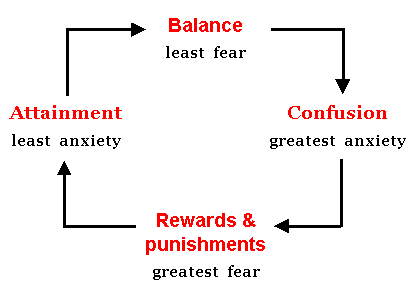
All the foregoing ideas in all three articles on conflict within idealism can be placed within another perspective, that of an idealism that is underpinned by psychological awareness. This perspective recognises the dominance of mental loops in the functioning of consciousness. A mental loop is simply the regular replay of stereotyped ideas and interpretations whenever a difficult situation replays itself in the experience of a person. A mental loop functions because the person is confused whenever he finds himself back in any difficult situation.
Confusion means only that the person is out of his depth in some kind of situation. He does not know how to handle skilfully that situation ; if it is a new experience, then he does not know how to learn from it. So he makes mistakes, and the most important mistakes are in his interpretations of that situation. Henceforth, when the situation repeats itself, he falls back on the same unskilful interpretations that he made initially (at the first occurrence of that situation).
A person's responses to situations vary over a wide range of intensity. I am considering only negative and unskilful responses. The most powerful intensity of response occurs in situations where he is confused. Mostly, confused situations reflect either mis-interpretations made in childhood, or else karmic mis-interpretations (that is, mis-interpretations made in previous lifetimes on Earth, and then carried over to the present Earth life). However, an occasional third influence is that of the spiritual world - by this I mean the influences of the person's higher self, of astrological influences, and of the personal God.
In the tests and trials of the spiritual seeker, this third influence is responsible for the conflicts within idealism. Ordinarily, when a person experiences prolonged periods of happiness and stability, his personal evolution ceases. Why not? Who wants to change, if by doing so they cease to be happy? So the spiritual world inflicts change on the person and on his social /political milieu. The person is forced out of his cocoon of happiness and balance, and thrown to the lions. Then the spiritual world waits to see what happens.
What is actually happening here is that the spiritual world forces the person to act and experience beyond his normal psychological boundaries and code of behaviour. The person becomes confused. If the experience is intense enough, then fear and anxiety are generated, and some degree of determinism is created. So now the person's responses in that kind of situation contain elements of determinism, and henceforth choice becomes restricted. What the person needs to do is to examine his unskilful responses. He has to learn (usually by trial and error) to create and erect new psychological boundaries and a new moral code, in order to handle better the unpleasant situation.
If the new boundaries and codes are better (in the view of the spiritual world), then the spiritual world rewards him ; if the new boundaries and codes are inadequate or inhibiting to personal evolution, then the spiritual world punishes him. The results of rewards and punishments lead eventually to the attainment of desirable character traits and relationship abilities which can solve the difficult situation. For each kind of difficult situation that the person encounters, the resolution will usually take several lifetimes.
When a difficult situation is resolved, the person attains a new state of balance and happiness (with respect to that kind of situation). However, balance is not a permanent state within evolution, so eventually the spiritual world will once more push the person past his boundaries and codes, and the process is repeated, again and again and again.
These ideas are a modern variation on an ancient concept. Somewhere I came across the following quotation, taken from classical Greece.
You are not a free agent, and you pay for the actions your destiny makes you perform, for thus the Gods decree.
| Top of Page |
These ideas can be put into
diagrammatic
form,
to produce Diagram 1:
the Loop of Becoming.
Becoming means the state of constant change. Within a spiritual
view of evolution, Becoming is the basis of all consciousness
that is undergoing evolutionary development. I indicate in the
diagram the changing importance of the fear and anxiety that
accompany each stage of the loop.
Diagram
1
The Loop of Becoming
The multitude of such loops of Becoming that the spiritual world imposes on human consciousness can be conveniently grouped into three themes.
The first theme consists of all the loops that are needed to acquire sufficient character traits and relationship abilities for the attainment of faith.
The second theme is the additional loops needed to mature the character traits and relationship abilities required for handling divine love.
The third theme is the additional loops needed to broaden character traits and relationship abilities for the pursuit of equanimity.
A person changes only a little in each lifetime. So the course of human evolution requires a great many lifetimes in the physical world.
The import of these ideas is that good and evil link together (within the subconscious mind). The boundaries between them keep shifting as evolution progresses. The presence of evil in the world does not mean that humanity is bad, nor does it mean that God is bad. Instead, evil is only the cauldron out of which newer and better traits of goodness are evolved. The real problem with evil is not so much that it exists, but that it takes a long time to change it.
A major cause of confusion is the process of abreaction. Abreaction is dialectical in its functioning.[4]. And it is the major means of producing changes of consciousness. The evolution of consciousness follows the abreaction pattern, and so is dialectical too. Evolution is never a continuous ascent to the heights of goodness. Instead, evolution progresses in a zig-zag manner: now two steps forward, then one step back ; now one step forward and two steps back.
| Top of Page |
My views on human consciousness often differ markedly from traditional religious and spiritual formulations and ideologies. The reason is that my centre of gravity is psychological and reflects the needs of a New Age. My perspective is neither spiritual nor religious, but instead is one of a non-materialistic idealism. Idealism is the middle ground between religion at the bottom and spirituality at the top.
When psychology and idealism are missed out, then religious and spiritual movements on Earth become unable to handle skilfully the problems of good and evil. In this situation, evil is assumed to arise solely from man, since it is not acceptable to think that God gives rise to evil influences. Hence man is assumed to be degenerate, and so needs a saviour God. Earth becomes a place that the seeker has to flee from.
However, once the reality of abreaction is accepted, then it can be understood that evil is an automatic by-product of having a subconscious mind. Evil is created through the unskilful handling of the subconscious mind. What is needed is to learn how to handle the mind in all its aspects. What is required is the study and exploration of psychology and ethics.
Therefore,
God no longer needs
to be a
saviour God.
Man
no longer
needs to be saved.
Instead,
man can begin to
work in harmony with the spiritual world in the slow, slow
process of creating new dreams of reality.
Life becomes what it has always been, a learning process.
| Top of Page |
| References |
The number in brackets at the end of each reference takes you back to the paragraph that featured it.
[¹]. I first describe the three levels of faith, higher self, and God in the article Orientations. [1]
[²]. I describe relativity in section 2, The Meaning of Relativity. [2]
[³]. This view of consciousness as having three components is explained in the first article on Emotion. See home page. [3]
[4]. A full analysis of Abreaction is in six articles on the Home page. [4]
| Home | Glossary | Top of Page |
The articles in this section are :
Conflict within Idealism - overview
Conflict within Idealism - three stages
Conflict within Idealism - ethics and three ideals
Copyright
© 2026
Ian Heath
All Rights Reserved
The
copyright is
mine, and
the articles
are free to use. They can be reproduced
anywhere, so long as the source is acknowledged.
Ian Heath
London, UK
If you want to contact me, use the address at the bottom of the Home page.
Also, since there are numerous articles on this site, please include the title of the article if you want me to clarify or discuss particular issues.
It may be a few days before I can respond to correspondence.